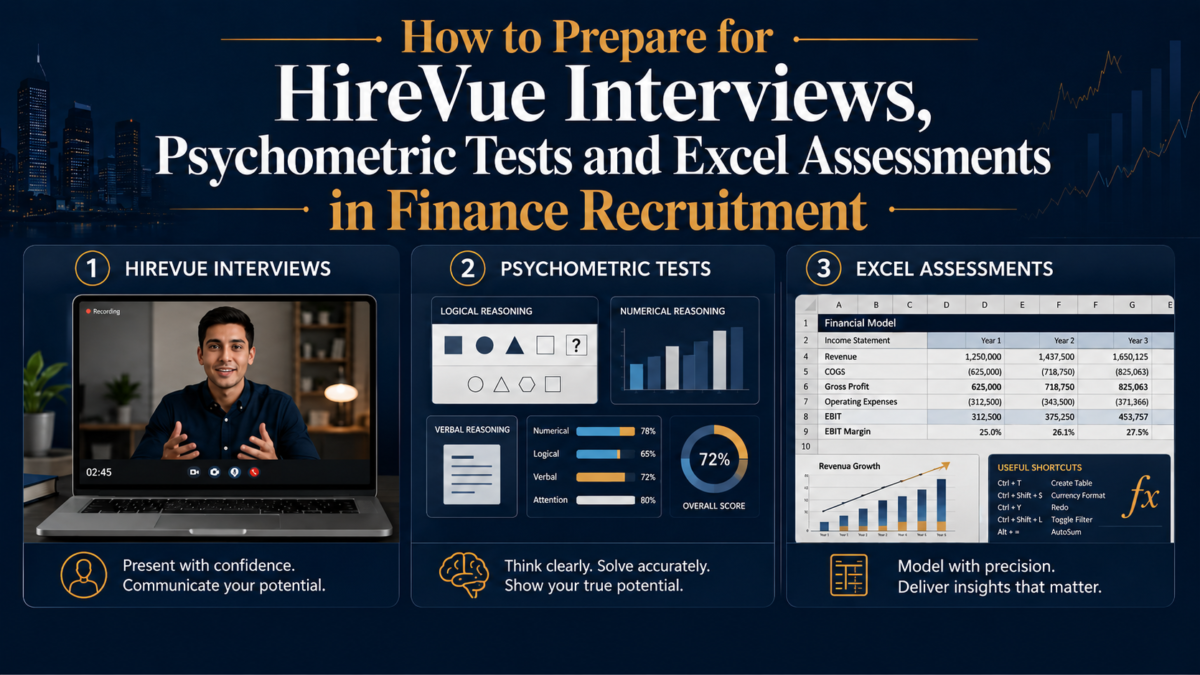
The finance recruitment process, particularly for investment banking, asset management, corporate finance, and analyst roles, has become highly competitive and technology-driven.
Platforms like HireVue for video interviews, standardized psychometric tests, and practical Excel assessments serve as efficient gatekeepers. Excelling in these stages requires targeted preparation that combines technical proficiency, behavioral readiness, and strategic practice.
This guide provides a comprehensive roadmap to help candidates stand out.
Understanding HireVue Interviews in Finance
HireVue is a leading one-way video interview platform used by major banks such as J.P. Morgan, Goldman Sachs, Morgan Stanley, Citi, and others.
Candidates record responses to pre-set questions, typically 3–8 in number, within strict time limits, often 30 seconds preparation and 60–180 seconds response per question.
The platform records video and audio, which AI and recruiters review for competencies like analytical thinking, communication, teamwork, resilience, and cultural fit.
Finance-specific questions often blend behavioral and technical elements. Common examples include:
- “Why investment banking / this firm?”
- “Tell me about a time you worked under pressure or overcame a challenge.”
- “Describe a time you analyzed data to make a decision.”
- “Walk me through a discounted cash flow (DCF) valuation.”
- “How do you stay informed about financial markets?”
Preparation Strategy for HireVue
1. Build a Story Bank Using STAR
Prepare 8–10 versatile examples structured with the STAR method: Situation, Task, Action, Result.
Allocate roughly 15–20% to context, 50–60% to your specific actions, and 20–25% to quantifiable results and lessons.
Tailor stories to finance themes: leadership in a deal team simulation, analytical problem-solving in internships, or ethical decision-making.
2. Practice Under Realistic Conditions
Record yourself answering questions with timers.
Review for filler words such as “um” and “like,” pacing, eye contact, and energy.
Speak slightly slower than normal, smile at the start, and maintain a professional tone. Aim for 90–150 seconds per answer.
Use the platform’s practice questions if available.
3. Technical and Environmental Setup
Ensure good lighting, with your face illuminated from the front, an eye-level camera, a neutral background, stable internet, and professional attire.
Test audio and minimize noise.
Look directly into the camera lens for “eye contact.”
4. Company and Market Awareness
Research recent deals, earnings, regulatory changes, and firm values.
Prepare concise responses on current events that demonstrate commercial awareness.
For structured HireVue practice tailored to finance roles, including banking-specific question banks and delivery feedback, check out targeted HireVue interview preparation resources.
TrendUp users can receive a 20% discount by using the code TRENDUP20 when signing up.
Mastering Psychometric Tests for Finance Roles
Psychometric assessments evaluate cognitive abilities, personality, and behavioral fit.
Finance employers commonly use tests from SHL, Talent Q or Korn Ferry, Hogan, or custom batteries.
These include numerical reasoning, verbal reasoning, logical or inductive reasoning, situational judgment tests, and personality questionnaires such as OPQ32.
Key Test Types and Tips
Numerical Reasoning
Interpret financial tables, charts, ratios, percentages, and data under time pressure.
Practice with finance-flavored data like balance sheets or market reports.
Focus on speed and accuracy. Aim for scores above 80% in practice tests.
Verbal and Logical Reasoning
Analyze passages or identify patterns.
Build reading speed and logical deduction skills.
Personality and Situational Judgment Tests
These assess traits like resilience under stress and ethical judgment.
Be consistent. Banks value reliability.
Effective Preparation Plan
- Take baseline practice tests to identify weaknesses.
- Drill daily with timed simulations.
- Review explanations thoroughly.
- Practice mental math.
Excelling in Excel Assessments
Excel proficiency is non-negotiable in finance for modeling, data analysis, reporting, and automation.
Assessments range from basic functions to advanced financial modeling, often in timed practical tests or case studies.
Core Skills to Master
Fundamentals
- SUM
- AVERAGE
- IF
- AND
- OR
- VLOOKUP
- XLOOKUP
- INDEX and MATCH
- PivotTables
- Conditional formatting
- Charts
Intermediate and Advanced
- SUMIFS
- COUNTIFS
- Financial functions such as NPV, IRR, and XIRR
- Goal Seek
- Scenario analysis
- Data validation
- Keyboard shortcuts
Finance-Specific
- Building three-statement models
- DCF valuations
- Sensitivity tables
- Professional dashboards
Use cell references for auditability and avoid hardcoding numbers.
Preparation Tips
- Practice with realistic datasets such as financial statements or transaction comparables.
- Time yourself on common tasks like data cleaning, PivotTable creation, and model building.
- Learn efficient workflows and error-checking techniques.
For in-depth training on financial modeling techniques that directly translate to assessment success, explore a dedicated corporate finance modeling module.
Additionally, comprehensive AI-based Excel modeling prep covering advanced functions, shortcuts, and scenario analysis can give you a decisive edge in these assessments.
TrendUp users can use the discount code TRENDUP20 to receive 20% off.
Integrated Preparation Timeline and Final Advice
Weeks 1–2
Focus on psychometrics and Excel fundamentals with daily practice tests.
Week 3
Build HireVue stories, record multiple mock interviews, and refine technical answers.
Final Days
Practice full simulations combining all three components.
Review performance and rest well.
Additional best practices:
- Tailor preparation to the specific firm and role.
- Maintain professionalism and attention to detail throughout.
- Seek feedback where possible.
- Stay updated on recruitment trends.
Success in these assessments signals strong potential for the fast-paced finance environment.
With deliberate, consistent preparation, focusing on structure, practice under pressure, and authentic delivery, you can confidently navigate the process and advance in finance recruitment.